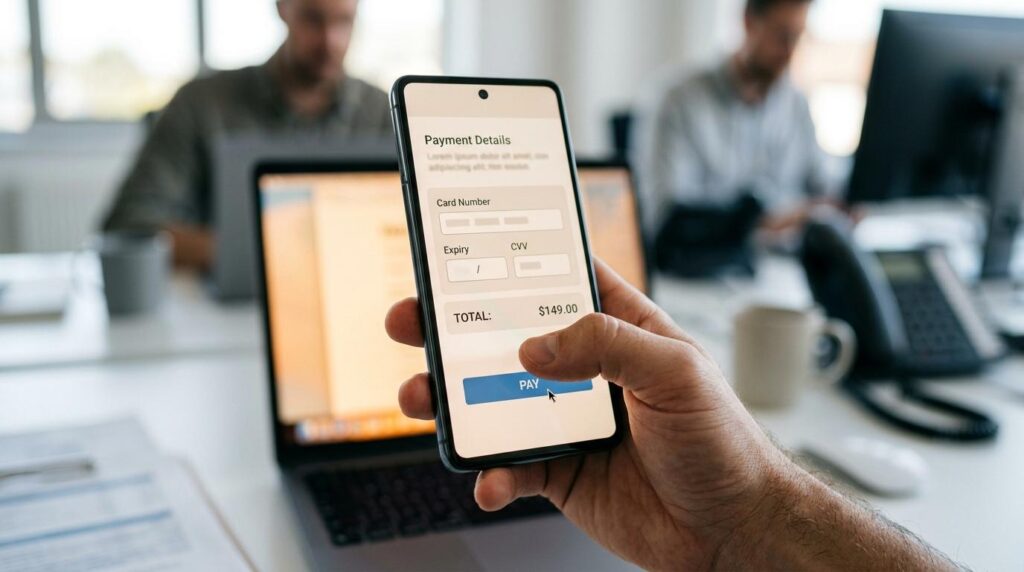

Customers no longer think in channels. They move from phone to laptop, from a social post to a website, from online browsing to an in-store purchase, often within the same buying decision. Businesses that treat each of those touchpoints as separate payment environments create friction without meaning to.
An omnichannel payment system solves that problem by connecting payments across every sales route a business uses. It gives merchants one joined-up payment backbone instead of a patchwork of disconnected tools, terminals, gateways and reports. That matters not only for customer experience, but also for fraud control, reconciliation, cash flow visibility and future growth.
What an omnichannel payment system means
An omnichannel payment system is a payment setup that links all customer payment touchpoints into one integrated platform. That can include an eCommerce checkout, card machines in store, mobile app payments, payment links, MOTO transactions, subscriptions, social commerce, and phone orders.
The key idea is continuity. A shopper might start a purchase on one channel and complete it on another, while the business still sees one customer record, one order history and one payment environment. Instead of separate systems trying to coexist, the payment layer is shared across the whole operation.
This is what makes omnichannel different from simply offering many ways to pay. A business can have a website, a shop counter and a call centre, yet still run payments in silos. True omnichannel payments connect those channels so data, reporting and customer context stay consistent.
After that foundation is in place, several benefits become possible:
- Unified reporting
- Shared customer payment history
- Cross-channel refunds
- Consistent payment methods
- Better fraud monitoring
Omnichannel payments vs multichannel payments
The terms are often used interchangeably, yet they are not the same.
A multichannel business sells through more than one route. An omnichannel business connects those routes so the experience and the payment data work together. That distinction may sound subtle, but in practice it has a major effect on operations.
| Model | How payments are managed | Customer experience | Back-office impact |
|---|---|---|---|
| Single-channel | One payment route only | Limited choice | Simple, but restrictive |
| Multichannel | Several separate payment systems | More choice, but inconsistent | Fragmented reporting and reconciliation |
| Omnichannel | One integrated payment platform across channels | Consistent and flexible | Centralised visibility and control |
In a multichannel setup, online and in-store payments may be processed by different providers, settled on different schedules and reported in different dashboards. In an omnichannel setup, those pieces are joined. That makes it far easier to manage growth without multiplying complexity.
How omnichannel payment systems work across sales channels
Behind the scenes, omnichannel payments rely on integration. Payment gateways, card terminals, APIs, mobile SDKs, tokenisation, fraud tools and merchant dashboards all feed into a shared platform or orchestration layer.
That shared layer enables real-time data flow. Inventory can stay in sync. Stored payment credentials can be safely tokenised and reused where appropriate. Refunds can be issued from a different channel than the original purchase. Support teams can see a customer’s transaction history without hunting through separate systems.
A modern omnichannel setup usually includes several moving parts working together:
- Gateway layer: authorises and routes online and remote payments
- POS integration: connects in-store terminals and contactless devices
- APIs and SDKs: link websites, apps and custom software to the payment platform
- Tokenisation: replaces card data with secure tokens
- Fraud controls: apply risk rules and monitoring across all channels
- Unified dashboard: brings reporting, settlements and chargeback management into one place
Cloud infrastructure also matters. If a business operates across locations, devices or markets, it needs payment data to update quickly and consistently. That is much harder to achieve with older, isolated systems.
Why omnichannel payment systems matter for business performance
The strongest case for omnichannel payments is commercial. Customers are more likely to complete a purchase when they can pay through their preferred route, with their preferred method, at the right moment. Every extra step, repeated data entry field or inconsistent checkout flow creates an opportunity for abandonment.
There is also an operational upside. When a finance team no longer has to reconcile separate payment systems for online, in-store and remote sales, reporting becomes faster and more reliable. That saves time, reduces manual errors and improves visibility over cash movement.
A joined payment model also creates a better quality data set. When payment activity is centralised, businesses can see trends more clearly: which channels convert best, which payment methods lift order value, where fraud attempts are rising, and where refunds or failed payments cluster. Those insights support stronger decision-making.
In practical terms, businesses often value omnichannel systems for four reasons:
- Revenue impact: more ways to convert customers without fragmenting checkout
- Operational efficiency: less duplication across systems, teams and reports
- Customer retention: smoother repeat buying and easier service interactions
- Scalability: new channels can be added without rebuilding the payment stack each time
For growing businesses, that last point is especially important. Expansion should not mean adding another isolated provider, another spreadsheet and another reconciliation process.
What customers expect from an omnichannel payment experience
Customers want continuity, even if they never describe it in those terms.
They expect to see familiar payment methods online and offline. They expect a business to recognise their order history. They expect returns, exchanges and support queries to be handled without confusion about where the original payment happened. When that experience feels joined up, trust grows.
Security expectations are just as high. People want fast checkout, yet they also want card details handled carefully, strong authentication where needed, and clear confidence that the same standards apply whether they are buying on a phone, by email link or at the till.
That combination of convenience and confidence is where omnichannel payments stand out.
Common omnichannel payment system challenges
The model is strong, but implementation still needs care.
Legacy systems are often the first obstacle. A retailer may have old card terminals, a separate online gateway, disconnected stock tools and manual refund processes. Bringing those into one payment environment takes planning, technical work and often a staged rollout.
Compliance is another major area. When more channels feed into one system, security has to be consistent everywhere. PCI DSS responsibilities, data protection requirements, tokenisation standards and fraud controls cannot be treated as optional extras. They are core to the design.
Businesses should also be realistic about internal change. Omnichannel payments often affect finance, operations, customer support, eCommerce and in-store teams at the same time. Training matters. So do clear workflows.
A few risks deserve close attention:
- Integration gaps: disconnected tools can lead to failed syncs or duplicate records
- Data quality: poor customer or order data weakens the value of centralisation
- Cost control: added channels can become expensive if pricing is not transparent
- Fraud exposure: more touchpoints mean more areas to monitor and protect
The strongest implementations are rarely the most complex on paper. They are the ones built with discipline, clarity and the right provider support.
What to look for in an omnichannel payment provider
Not every payment provider offering “omnichannel” capability is delivering the same thing. Some provide many payment products, but not one truly unified platform. Others support only a narrow mix of channels or rely on third-party patchwork for reporting.
A better approach is to look at how well the provider connects the full payment journey. Can it support online checkout, card-present payments, pay by link, MOTO, recurring billing and mobile wallets within one environment? Can merchants monitor all of that from a single portal? Can fraud tools and settlement reporting be viewed in one place?
When assessing providers, it helps to focus on a practical checklist:
- Channel coverage: online, in-store, mobile, remote and recurring payments
- Integration options: APIs, plugins, hosted pages and terminal support
- Security standards: tokenisation, encryption, fraud screening and compliance support
- Global capability: multi-currency acceptance and cross-border reach
- Support quality: responsive onboarding and dependable ongoing service
Transparent pricing matters too. Low headline rates mean little if hidden charges appear around setup, reporting, chargebacks or alternative payment methods. For many businesses, the right provider is the one that balances cost, flexibility and control.
How CardPayGO supports omnichannel payment operations
For businesses looking for a more connected payment model, CardPayGO positions its platform around exactly that need: one environment for accepting and managing payments across channels. Its offering spans online gateway services, in-store card machines, mobile terminals, payment links, MOTO payments, shopping cart support, virtual IBAN accounts and cross-border capabilities.
That breadth matters because omnichannel payments are only useful when the channels a business actually uses can be brought together. A merchant may need card-present payments in one part of the business, recurring billing in another, and remote payment collection for invoices or phone orders. A unified approach reduces the need to stitch those together manually.
CardPayGO also focuses on the operational side of omnichannel payments, not only payment acceptance itself. Features such as a single merchant portal, rapid onboarding, AI-driven fraud prevention and support for global payment flows speak directly to the issues many growing businesses face.
| CardPayGO capability | How it supports omnichannel payments |
|---|---|
| Online payment gateway | Connects website and digital checkout payments |
| In-store card machines and mobile terminals | Brings physical payment acceptance into the same wider payment environment |
| Pay by email links and MOTO | Extends payment collection beyond standard checkout flows |
| eCommerce integrations | Speeds deployment across major online selling platforms |
| AI fraud prevention tools | Applies risk controls across multiple payment touchpoints |
| Unified portal | Centralises reporting, monitoring and transaction management |
| Virtual IBAN and cross-border tools | Supports international collection and fund movement |
For businesses serving customers in more than one market, the ability to combine local payment acceptance with centralised oversight can be especially valuable. The same is true for sectors with mixed sales models, including retail, hospitality, travel, subscriptions and marketplaces.
Signs a business is ready for an omnichannel payment system
Many businesses need omnichannel payments before they realise it.
If teams are logging into multiple dashboards to track sales, if refunds are awkward across channels, if customer records are split between systems, or if expansion into new channels feels slow and messy, the payment architecture may be holding growth back. That is often the point where a unified model starts to shift from a nice-to-have into a commercial priority.
A business does not need to be a national chain to benefit. Smaller merchants, subscription businesses, service providers and fast-growing online brands can all gain from connected payments when they want simpler operations, stronger visibility and a more consistent customer experience across every place they sell.